

IT and OT integration with a event-driven broker and AC4DC
The integration of IT and OT combines the capabilities of two formerly separate worlds (scalability, security, versioning)
1/6
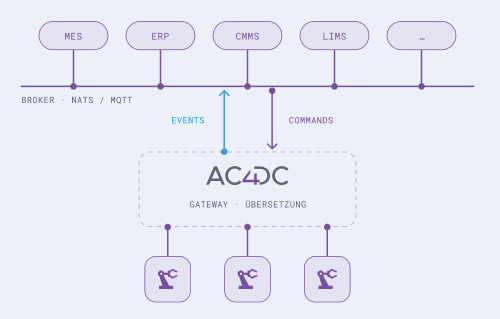
Integrating IT and OT using a broker (NATS.IO, MQTT, etc.) and AC4DC creates a high-performance, lightweight and secure communication backbone that semantically enriches machine data in real time and provides it as an industrial unified namespace. The strict decoupling of producers and consumers, together with support for persistent data stream buffering, enables future-proof, scalable networking of the entire shop floor with modern enterprise applications.
Today
Communication between IT and OT often takes place via rigid point-to-point connections that make flexible and scalable networking difficult. In addition, machine data is often available as unstructured raw data without sufficient semantic context. This limits the end-to-end use of production data in real time for higher-level enterprise applications.
With AC4DC
Secure and scalable networking of the entire shop floor
AC4DC in combination with a broker enables end-to-end, secure and scalable networking of the entire shop floor with enterprise IT. Production data is available in real time and in a uniformly structured form for MES, ERP, cloud and AI applications.
Event-driven architecture
AC4DC in combination with broker technologies such as NATS.IO, MQTT etc. creates an open, event-driven communication architecture. The broker acts as a lightweight, high-performance and secure communication backbone between IT and OT. AC4DC captures and processes machine data in real time, enriches it semantically and provides it in a structured way according to the principle of the Industrial Unified Namespace (UNS).
Your benefit
Decoupling the systems increases the flexibility, fault tolerance and extensibility of the entire architecture. At the same time, bidirectional communication enables a controlled exchange of production data and control information while maintaining the IT/OT security boundaries. This creates a future-proof foundation for the digitalization and data-driven optimization of production
Capture and preprocessing at the edge gateway
2/6
Process
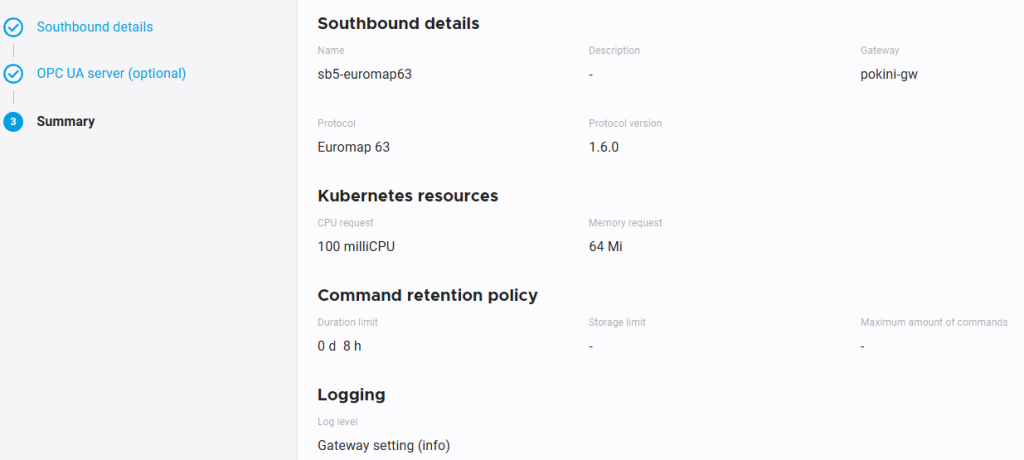
- Using specific southbound connectors, the AC4DC gateway reads the measurement and status data from the machine controller cyclically or event-driven, checks the raw values for plausibility and enriches them with timestamps equipment metadata and more.
Platform tasks
- Southbound protocol abstraction and acquisition of field data:
AC4DC connects a wide variety of OT PLCs and protocols (Siemens S7, Modbus, OPC UA, Euromap 63, Heidenhain, stream sockets, etc.) independently of the manufacturer and captures states, process values and counter readings directly at the physical assets.
Semantic transformation and topic structuring
3/6
Process
- Publish to hierarchical NATS subjects:
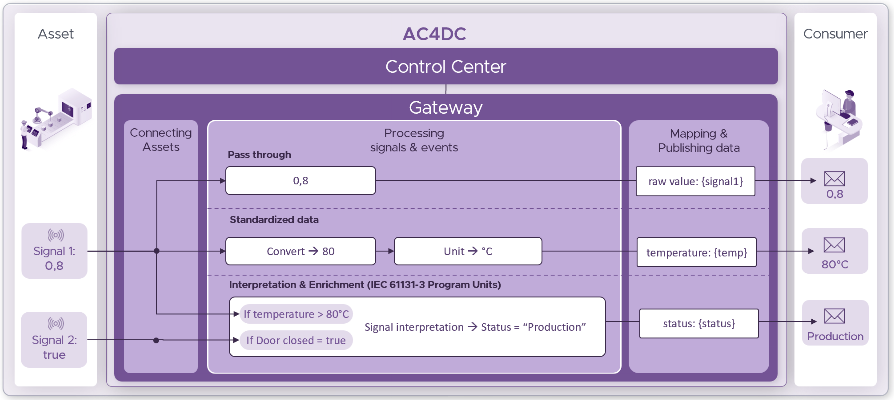
The gateway formats the prepared data records (for example as structured JSON or template payloads) and publishes them in encrypted form to a unique broker subject within the company’s topic hierarchy.
Platform tasks
- The raw field signals are normalized at the edge, transferred into standardized data models and assigned to hierarchical NATS subjects to ensure a transparent representation in the industrial Unified Namespace.
Persistence and buffering
4/6
Process
- If the process requires guaranteed delivery, the broker takes over the message in the target stream, stores it redundantly and thus guarantees decoupling even in the event of temporary connection drops between the edge and the data center.
- Targeted distribution via subject filters and wildcards:
The broker routes the events to the authorized recipients in the IT landscape exactly according to configured consumer subscriptions (e.g. using flexible wildcards such as > or *).
Tasks of OT-architecture
- Providing hybrid messaging patterns using the example of NATS Core & JetStream):
Depending on the use case, the broker layer provides ultra-fast, stateless publish/subscribe (Core NATS for high-frequency telemetry) or persistent, fail-safe event streams with at-least-once delivery guarantees (NATS JetStream for quality- and order-critical events). - Securing the security and network zones:
The NATS infrastructure encapsulates the interface between OT networks and IT systems and enforces modern security mechanisms such as TLS encryption, mTLS certificates, NKEY challenge-response procedures and decentralized JWT authentication.
Consumption and further processing in the IT applications
5/6
Process
- Consumption and further processing in the IT applications:
IT consumers (such as MES, CMMS, LIMS, ERP, QMS etc.) receive the data streams independently of one another and initiate automated follow-up actions such as OEE calculations, maintenance tickets or ERP postings. - Feedback and execution of IT commands:
If an IT system issues new specifications (such as order changes or machine stops), a corresponding command event is sent to the gateway via the broker, translated back by AC4DC into machine-readable control commands and could then be written to the target PLC.
Tasks of OT-architecture
- Decoupled multi-consumer provisioning (northbound):
The broker (NAT.IO, MQTT, etc.) distributes incoming machine data in parallel and load-optimized to a wide variety of IT target systems (such as SAP DM, MES FLEX, ticketing tools or cloud analytics) without placing additional load on the source systems on the shop floor. - Bidirectional command and specification control:
Using request-reply patterns and dedicated command streams, the broker architecture enables the secure transmission of setpoints, recipes or production releases from the IT levels back into the AC4DC Industrial Data Layer.
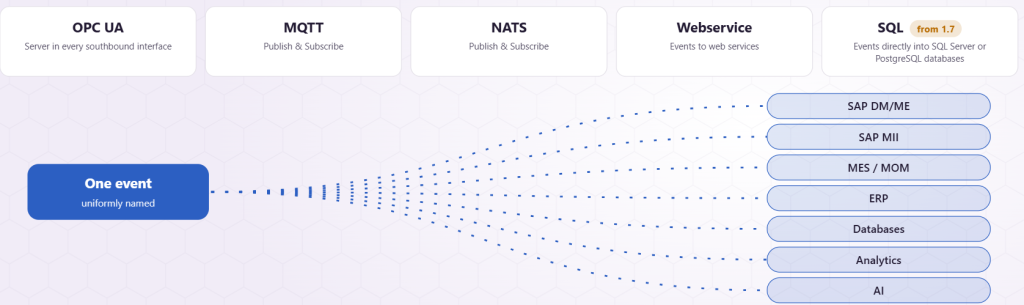
Using broker technology (NATS.IO, MQTT, etc.) for IT/OT integration with AC4DC offers decisive technological and business advantages
6/6
Added value
- Radical decoupling and scalability: The publish/subscribe paradigm completely eliminates rigid point-to-point connections. New IT applications, edge apps or analysis tools can be added as subscribers at any time without having to reconfigure existing machine programs or gateways.
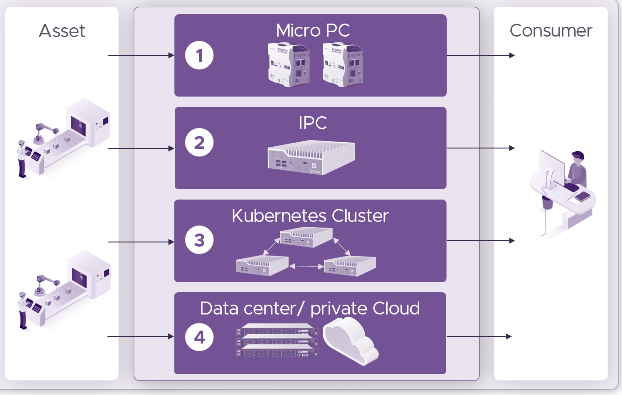
- Minimal resource footprint with maximum throughput: Compared to heavyweight enterprise brokers, NATS stands out for its tiny memory footprint (container size approx. 12 MB) and extremely low CPU overhead. This enables smooth operation both on resource-constrained edge micro PCs and in large Kubernetes clusters.
- Robust fault tolerance through store and forward: No quality- or process-relevant shop floor data is lost, even during network fluctuations or maintenance windows of the enterprise IT, because the data is buffered locally and delivered in full once the connection is restored.
- Maximum security at the IT/OT interface: Granular authorization at subject level, NKEYs and decentralized JWTs ensure that IT systems only subscribe to authorized data streams and that no unauthorized interventions in safety-critical OT processes can take place.
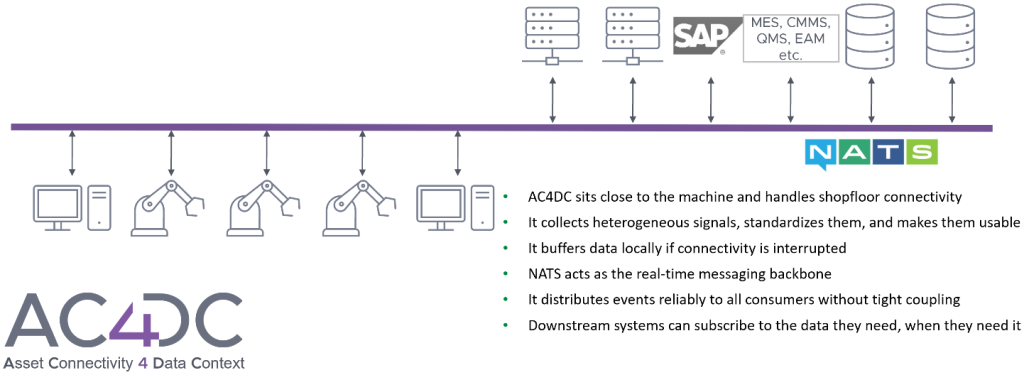
- Uniform data basis (Unified Namespace): Structured addressing and semantic data enrichment create a uniform, cross-departmental real-time data space that serves as a reliable foundation for business intelligence, predictive maintenance and industrial AI.