
The foundation
Platform Core
Model once. Use everywhere. The AC4DC foundation turns individual solutions into a company-wide standard – with a scalable architecture, a semantic data model and clear governance.
Start small. Scale fast.
Lean to start. Scaled to the enterprise.
The platform is installed in less than a day and runs on lean system requirements. Its architecture grows with you: from a single plant to the entire enterprise, from a single server to the data center.
Start
< 1 day
platform installation
Start
Lean
system requirements
Scale
Plant → enterprise
scalable architecture
The challenge
Every project starts from scratch
Without a common foundation, effort grows with every use case, every plant and every system – and in the end the data doesn’t fit together.
Isolated solutions
Every integration is built and maintained individually. Knowledge lives in scripts and in people’s heads.
Data sprawl
The same things have different names in each plant and machine. Comparisons and AI applications fail because of the data foundation.
Changes are risky
Without versioning, it is hard to trace what was changed where – rollouts become a risk.
How it works
Model. Roll out. Use.
Structures modeled once become a standard that carries across all plants.
01
Model
In libraries
Data structures, signal processing and messages are created once and stored in libraries.
02
Roll out
Versioned
Templates and libraries are versioned, published and transferred to assets and gateways in a controlled way.
03
Use
The same everywhere
All systems receive the same, consistently named events – from MES to AI.
Architecture
From control cabinet to cloud
AC4DC processes data where it is generated and manages everything centrally. The architecture grows with you – from the first gateway to a group-wide structure.
Gateway
Runs close to the data source: connectivity, signal and event processing, provisioning.
Control Center
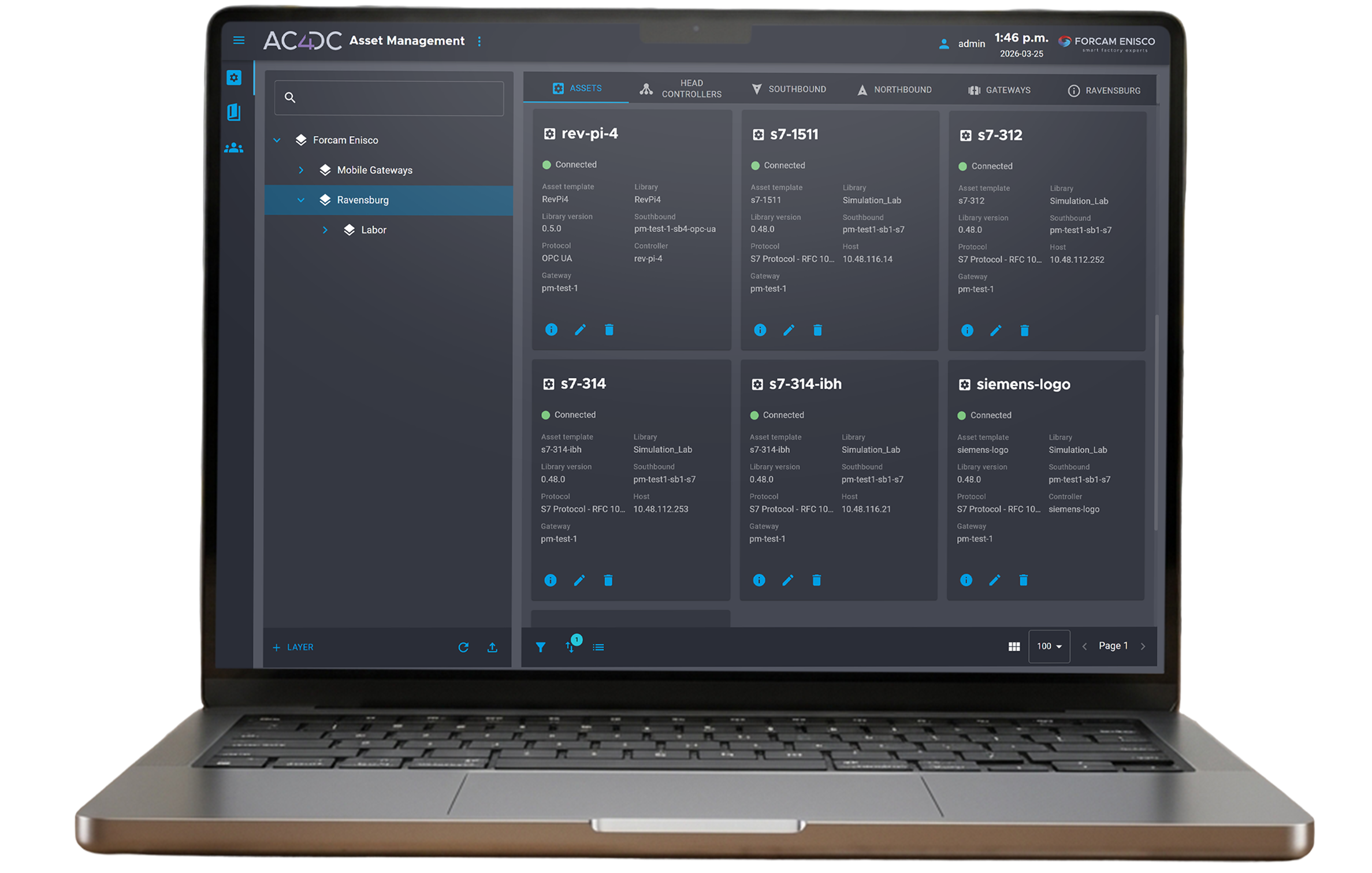
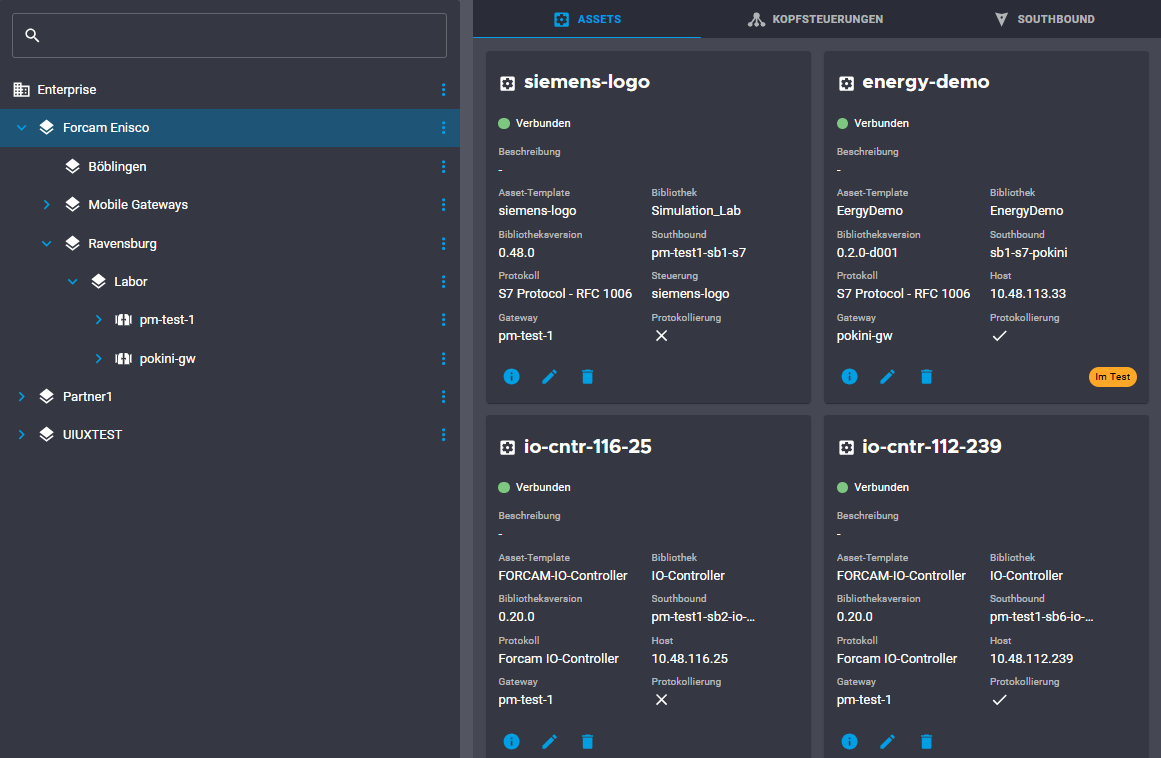
Central management of assets, gateways, interfaces and libraries – via user interface or API.
Scalable
More gateways for more plants – from mid-sized companies to large corporations.
Containerized
Kubernetes-based, on mini IPC, industrial PC, server or in the cloud.
Fail-safe
Message buffers bridge connection losses to third-party systems.
Secure
Encrypted communication, few third-party components, roles and permissions down to site level.
Semantic Data Model
One data model for all systems
AC4DC converts signals at runtime into a semantic event structure – consistently named, with context from the shop floor and comparable across machines.

Data structures
Define the content and structure of events and commands – the smallest element of structuring.

Program units
Signal processing according to the PLC standard IEC 61131-3, with predefined function blocks and editor.

Message definitions
Determine the structure in which events are sent to which third-party system.

Consistently named
The same things have the same names everywhere – the basis for comparisons, analytics and AI.
Governance
Standards that scale
Governance turns a good solution into a standard: reusable, versioned and traceable – across all plants.
Libraries
Reusable objects are created, versioned and published centrally.
Asset templates
Connect new assets of a type – all that’s missing is the connection data.
Controlled versions
For every connection, it is defined which library version it uses.
Dependencies in view
One change in one place – all affected configurations are flagged.
Rollout and rollback
Roll out new versions selectively and revert them if needed.
Roles and permissions
Permissions down to individual production sites.
IT & Data Integration
Open to every system
The standardized events are available via established protocols – read and write, without proprietary interfaces.
OPC UA
Server in every southbound interface
MQTT
Publish & Subscribe
NATS
Publish & Subscribe
HTTP
Send events to web services
SQL (from version 1.7)
Events directly into SQL Server or PostgreSQL
Typical target systems: SAP DM/ME, SAP MII, MES and MOM systems, databases, analytics and AI. AC4DC itself can also be configured via an API.
AI Readiness
Ready for AI
AI is only as good as the data it accesses. AC4DC delivers the stable, semantically structured data foundation from the shop floor – AI applications build directly on it.
Data with meaning
Consistently named events with context – AI understands the data without complex mapping.
Questions in everyday language
AI agents answer questions about machines and orders – together with 4IoT.
Agentic AI
Production context from AC4DC for AI agents in troubleshooting – together with SABO IT.
FAQ
Frequently asked questions
How is AC4DC structured?
AC4DC consists of gateways and the Control Center. The gateways run close to the machine: they connect controllers, process signals into events and provide them to third-party systems. The Control Center is the central management environment for assets, gateways, interfaces and libraries – operated via the user interface or an API.
What does “Model once. Use everywhere.” mean?
Data structures, signal processing and messages are modelled once in libraries. Every further machine of the same type uses this model via a template – only the connection details need to be added. All downstream systems receive the same, consistently named events.
How does AC4DC scale to multiple plants?
Through the number of gateways – from a single plant to a group structure with many sites. Libraries and templates are maintained centrally and reused everywhere. Roles and permissions control access down to individual production sites.
How are changes rolled out in a controlled way?
Libraries are versioned and published. Each connection defines which version it uses. When a new version is created, AC4DC flags all affected configurations. Changes can be rolled out in a targeted way – and rolled back if necessary.
Is AC4DC ready for AI?
Yes. AI is only as good as the data it accesses. AC4DC delivers semantically structured, consistently named data with shop floor context – via open interfaces. Together with partners, we are already demonstrating this, for example with AI agents that answer questions about production in everyday language.
Do I need programming skills?
No, automation know-how is sufficient. Signal processing is based on the standard for PLC programming (IEC 61131-3). AC4DC includes predefined function blocks for basic operations, and a Structured Text editor is available for custom logic.
Does AC4DC run in the cloud or on premises?
Both are possible. AC4DC is containerized software for Kubernetes and runs on a mini industrial PC, an industrial PC, a server or in the cloud. Optionally, the gateway can run directly in the control cabinet next to the PLC.
What happens if the connection is lost?
If the connection to a third-party system is briefly interrupted, the gateway buffers the events and transmits them as soon as the connection is restored. How long and how many events are buffered is configurable.
How secure is AC4DC?
AC4DC reduces the attack surface with a lean architecture and few third-party components. Communication between the gateway and third-party systems is encrypted. Because the gateway can run right next to the controller, the unencrypted path is kept to a minimum. Roles and permissions control who can see and change what.
One foundation for all plants
In a demo, we show you how to model once with AC4DC and use the standard in all your plants.