

Energy monitoring with AC4DC: consumption data in the order context
Energy monitoring
1/6
Energy monitoring with AC4DC turns heterogeneous consumption data from the shop floor into standardized, order-contextualized data streams and thus acts as a reliable single source of truth for the entire resource consumption of production. On this solid data basis, manufacturing companies can sustainably reduce costs and CO₂ emissions, precisely meet regulatory ESG requirements and optimize their production processes with a focus on energy.

Today
Machines that have evolved
over time are often characterized
by proprietary protocols and isolated
data silos. As a result, every new
integration becomes a stand-alone project.
With AC4DC
Verbrauchsdaten sklaierbar erfassen
AC4DC captures comsumption data at high frequency and across multiple locations directly on the shop floor, thereby serving as the single source of truth for all consumption data from production assets.
Contextualizing consumption data with master data
AC4DC derives machine status, converts physical units, assigns quantity and quality information, and links machine data to order data. This semantically enriched data is made available in encrypted form for ISO 50001-compliant energy management systems, data lakes, and detailed planning.
Your Benefit
Transparency at the machine level is the foundation for realizing cost-saving potential and allocating costs according to the source. This creates a verifiable database for audits and sustainability reports. The greatest benefit is that, once established, the data foundation can be reused for other applications such as OEE, quality, and AI.
Context initialization and provision of production information
2/6
Process
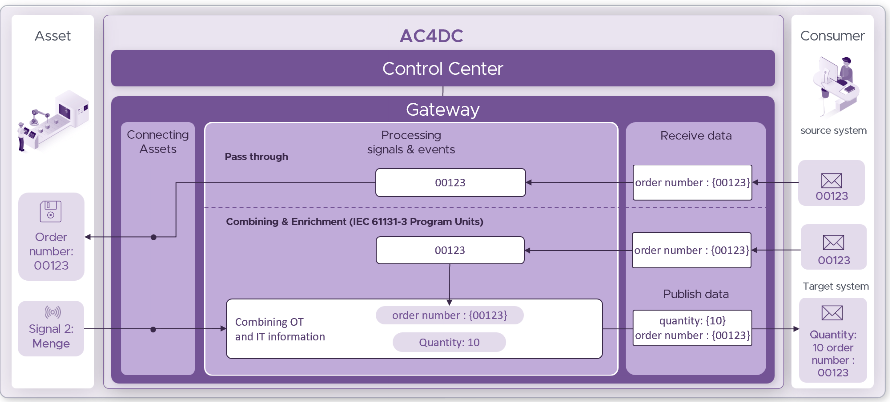
- When a production order starts or the operating mode changes, AC4DC takes over the order and status data (e.g. order ID, operation, target item, target quantity) from higher-level systems or directly from the machine controller and assigns it to the physical asset for energy and (resource) monitoring and its efficiency.
Platform tasks
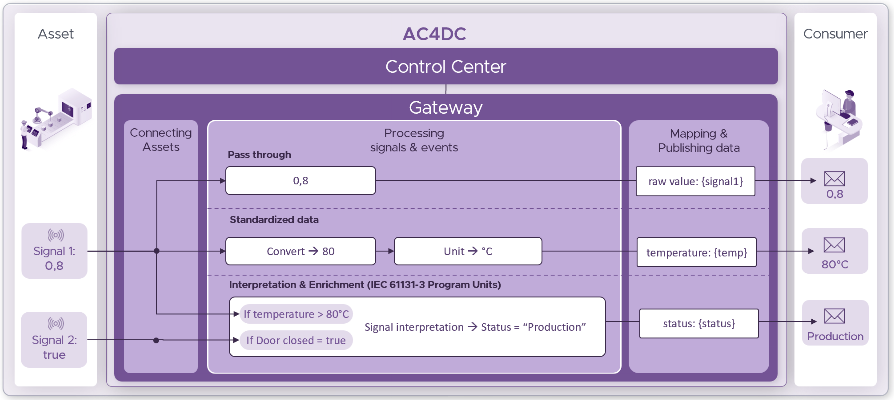
- Heterogeneous meter and asset connectivity (southbound integration):
AC4DC reliably connects a wide variety of measuring devices, smart energy meters, flow sensors and utility meters for electricity, compressed air, gas, water and auxiliary materials on heterogeneous existing and new equipment via industrial protocols and edge gateways
Continuous signal capture at the measuring points
3/6
Process
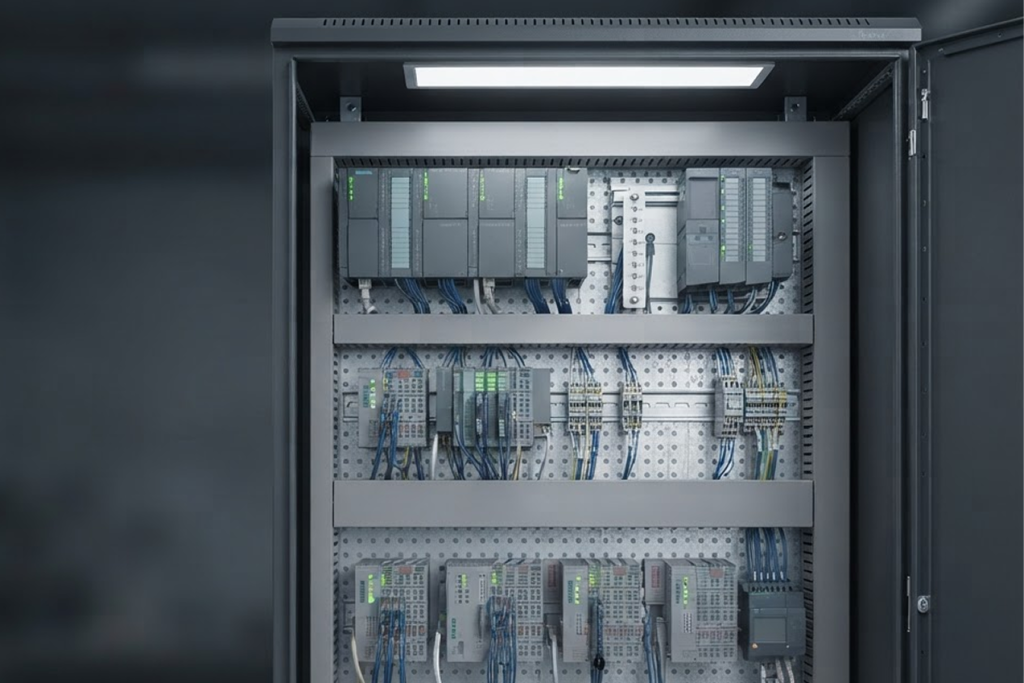
- The measuring equipment mounted on machines, lines and supply lines continuously records consumption and load curves (e.g. active power in kW, cumulative kWh, compressed air flow rate in m³/h) and transmits the raw signals to the local AC4DC gateway
Platform tasks
- Capture and normalization of raw consumption data:
The platform captures high-frequency meter readings and instantaneous power values, removes signal noise or meter overflows and converts inconsistent manufacturer-specific data structures at the edge into a standardized, comparable physical unit model
Semantic fusion with production and order metadata
4/6
Process
- Local data filtering and plausibility checks:
The AC4DC gateway filters out measurement errors, performs plausibility checks, precisely aligns timestamps and structures the incoming raw values in standardized data structures. - Contextualization and status correlation:
In the event model, the standardized measured values are combined with the actual operating state and the order data, so that it is possible to differentiate exactly which share of consumption is attributable to value-adding processing, setup or unproductive waiting times
Platform tasks
- AC4DC links the pure consumption values with the operational context – including production order, operation, item number, material batch and specific operating states such as production, setup, break or downtime.
- Calculating consumption-related edge KPIs:
By logically linking quantity, cycle and energy data, AC4DC pre-calculates deterministic key figures at the edge (e.g. energy consumption per good part, specific compressed air demand per machine stroke or base load in standby).
Detecting consumption peaks and anomalies
5/6
Process
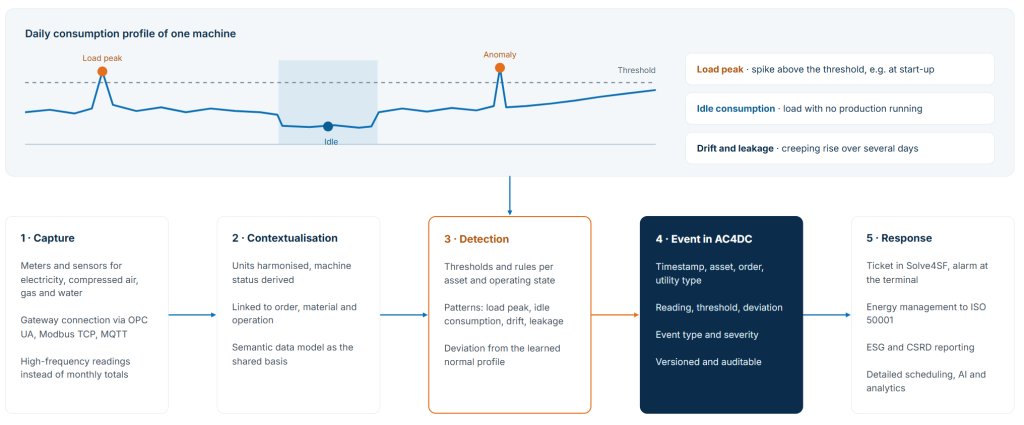
- Edge calculation and event generation:
AC4DC processes the data in integrated program units into meaningful key figures (e.g. energy intensity per unit produced) and generates immediate notifications or trigger events when defined limit values are exceeded. - Sending to energy management and enterprise systems:
The fully prepared, tamper-proof energy and resource data records are transmitted in encrypted form to target systems such as corporate sustainability platforms, ISO 50001 tools, ERP cost accounting modules or planning applications for energy-optimized sequence planning
Platform tasks
- Detecting consumption peaks and anomalies:
The platform monitors the ongoing consumption data streams for atypical load peaks, leaks in compressed air or media circuits and unusually high standby consumption outside regular production times. - Standardized and encrypted northbound distribution:
AC4DC provides the contextualized energy data records in a decoupled manner for multiple consumers via secure communication standards (such as MQTT, NATS, SQL or OPC UA) – from operational energy management and ERP/MES to detailed production scheduling.

AC4DC in the context of energy monitoring opens up tangible economic, ecological and strategic advantages for companies
6/6
Added value
- Direct cost reduction and peak load management: By uncovering energy-intensive, non-value-adding operating phases (e.g. unnecessary standby consumption during breaks or expensive load peaks when large consumers start up at the same time), energy costs can be significantly reduced and grid fees optimized.
- Cause-based product cost calculation: Instead of allocating energy costs across the board via overhead surcharges, AC4DC enables an exact post-calculation of the actual energy and media consumption per manufactured component or production lot.
- Audit and reporting reliability for ESG and CSRD: Companies receive reliable, tamper-proof and fine-grained consumption data directly from the shop floor, which replaces estimates and serves as a solid basis for CSRD reporting, the EU taxonomy and audits in accordance with ISO 50001 and ISO 14001.
- Energy-oriented production planning: Transferring the aggregated consumption data to planning systems makes it possible to schedule particularly energy-intensive production steps at times of lower electricity tariffs or lower grid load.
- Precise calculation of the product carbon footprint (PCF): The complete allocation of real electricity and auxiliary material consumption to components provides the empirical basis for meaningful life cycle assessments (LCA) and differentiated CO₂ balances for customers and certifiers.
- Cultural lever and behavioral change: The transparent visualization of consumption at the workstation creates immediate awareness in the shop floor team, so that operational efficiency potential and resource savings are realized responsibly in everyday work.